


Organizations are investing heavily in new experiences, automation, and digital transformation. Yet a hidden challenge continues to slow innovation:
Why does every new initiative seem to start with another integration project?
While customer expectations evolve rapidly, many organizations spend significant time connecting systems rather than creating value. The result is growing complexity, slower delivery, and reduced agility.
The organizations that move fastest are not necessarily building more. They are rebuilding less.
Business Challenge
Every new initiative promises progress. But behind many initiatives lies the same question:
“How do we connect it?”
Over time, organizations accumulate layers of connectivity, dependencies, and operational overhead. The challenge is not innovation. The challenge is sustaining innovation without increasing complexity.
Technical Solution
- What if integration was not a project?
- What if it was a reusable capability?
A common service foundation allows organizations to standardize access to business capabilities and reuse them across multiple experiences.
Instead of building new connections repeatedly, teams build once and reuse continuously.
Compatibility
A reusable foundation is not designed for one initiative. It is designed for every initiative that follows.
The goal is simple:
Support today’s needs without limiting tomorrow’s opportunities.
Architecture
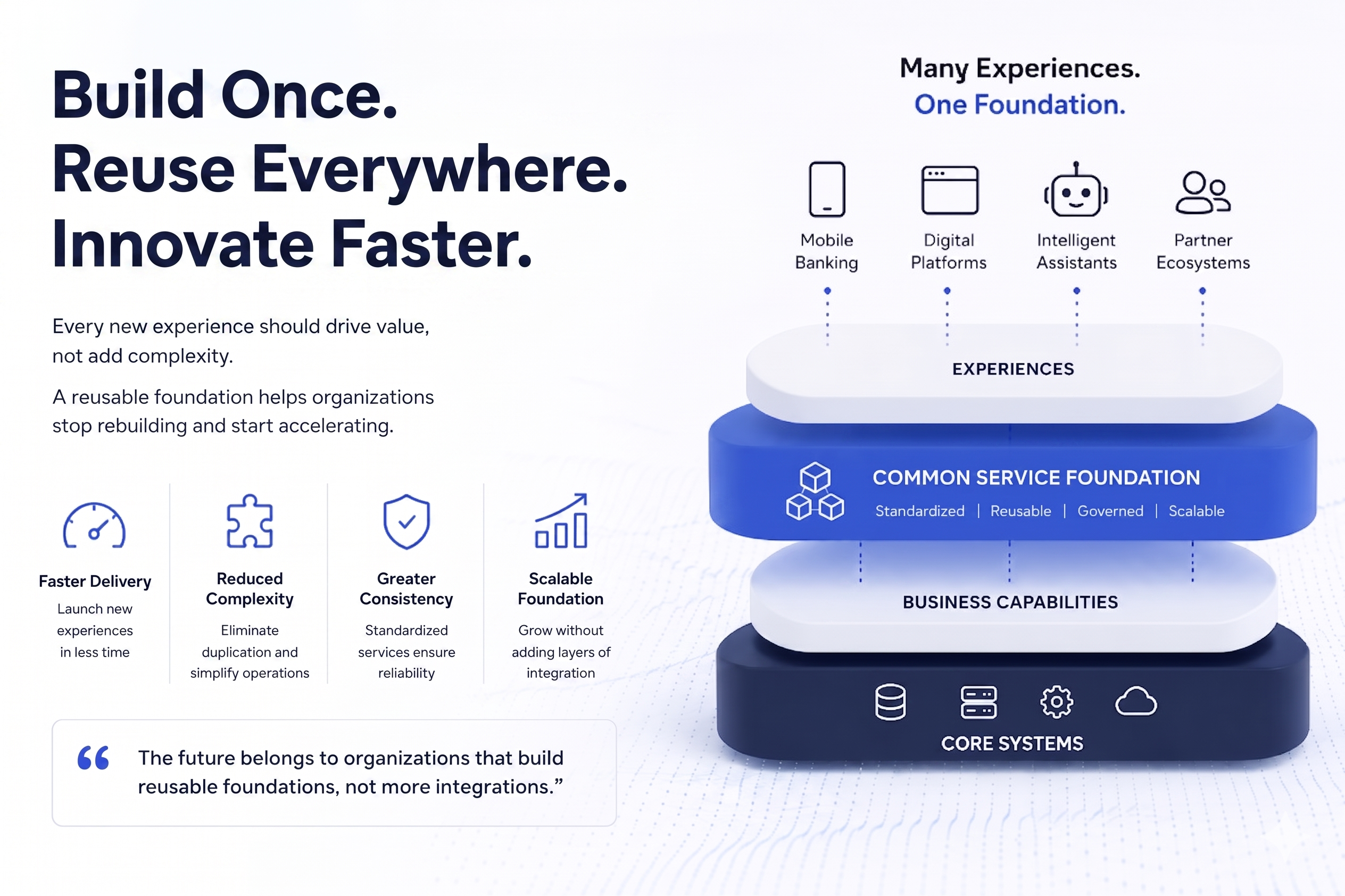
The architecture centers around a common service layer that separates business capabilities from individual experiences.
This creates:
- Consistency
- Reusability
- Scalability
- Operational simplicity
The result is a foundation that supports growth without increasing complexity.
Execution
Successful execution begins with a shift in mindset.
From:
“How do we build this?”
To:
“How do we reuse what already exists?”
Organizations that adopt this approach spend less time recreating foundations and more time delivering value.
Integration
Integration should accelerate innovation, not become a barrier to it. By establishing a reusable service model, organizations reduce duplication and simplify the onboarding of new experiences.
The focus shifts from connecting systems to enabling outcomes.
Memory Management
As platforms grow, consistency becomes increasingly important. A centralized foundation helps organizations manage business rules, service configurations, and operational controls in a predictable and scalable way.
This ensures that growth does not come at the expense of manageability.
Services Used
The foundation provides access to common business capabilities through a consistent model. Rather than creating separate implementations, organizations leverage shared services that can support multiple experiences over time.
Project Outcome and Impact
What changes when organizations stop rebuilding?
They gain:
- Faster delivery
- Reduced complexity
- Greater scalability
- Improved consistency
- More capacity for innovation
Perhaps most importantly, they gain speed. And in today’s environment, speed is often the difference between leading and following.
Conclusion
The future does not belong to organizations that launch the most projects. It belongs to organizations that create the strongest foundation beneath them. The real competitive advantage is not adding more experiences. It is eliminating the need to rebuild the same foundation every time a new experience arrives.
