



Artificial Intelligence is no longer an experimental technology reserved for innovation labs. Today, AI powers customer support, business operations, software development, knowledge management, decision-making, and countless enterprise workflows. As organizations increasingly depend on AI for critical business functions, one question becomes more important than ever:
Can businesses afford to rely on a single AI provider or model?
The answer is becoming increasingly clear: they cannot.
Just as modern enterprises do not rely on a single server, database, or internet connection, they should not rely on a single AI provider. Building resilient AI agent networks with multi-provider integration is about ensuring reliability, flexibility, and long-term sustainability in an AI-driven world.
The Growing Dependence on AI
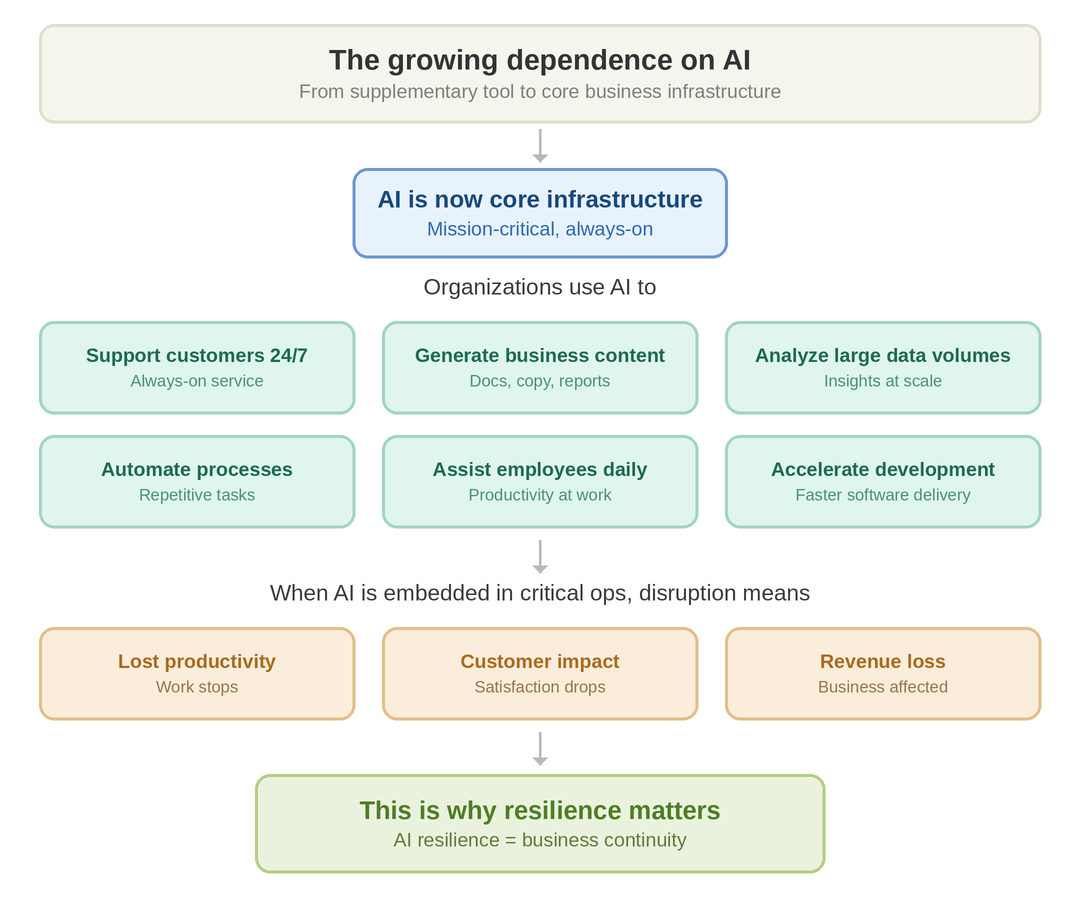
As AI becomes embedded into mission-critical operations, the impact of disruptions grows significantly. If an AI service becomes unavailable or underperforms, the consequences are no longer limited to inconvenience—they can directly affect productivity, customer satisfaction, and revenue. This shift is exactly why resilience matters.
Why Reliability Has Become a Business Requirement
Businesses expect critical systems to be available at all times.
Imagine if:
- A customer service platform suddenly stopped responding.
- Employees could not access AI-powered knowledge assistants.
- Automated business processes failed midway through execution.
- Internal productivity tools became unavailable during peak hours.
In many organizations, these scenarios are no longer hypothetical. AI is increasingly becoming part of daily operations.
Building resilient AI agent networks ensures that AI capabilities remain available even when individual providers experience issues. The goal is not simply to improve technology—it is to protect business continuity.
The Risk of Vendor Dependency
One of the biggest concerns organizations face today is becoming too dependent on a single AI provider. History has shown that technology landscapes evolve rapidly. New providers emerge, pricing models change, service limitations evolve, and innovation happens at an unprecedented pace.
Organizations that tightly couple their AI strategy to one provider may face challenges such as:
- Limited flexibility.
- Increased costs.
- Reduced bargaining power.
- Slower adoption of new technologies.
Multi-provider integration helps organizations maintain control over their AI strategy rather than allowing their strategy to be dictated by a single vendor.
This flexibility is becoming a significant competitive advantage.
The Need for Organizational Agility
- The pace of AI innovation is unlike anything most industries have experienced before.
- New foundation models are released regularly.
- Capabilities improve every few months.
- Performance benchmarks change constantly.
- Organizations that can quickly adapt to these changes gain a strategic advantage.
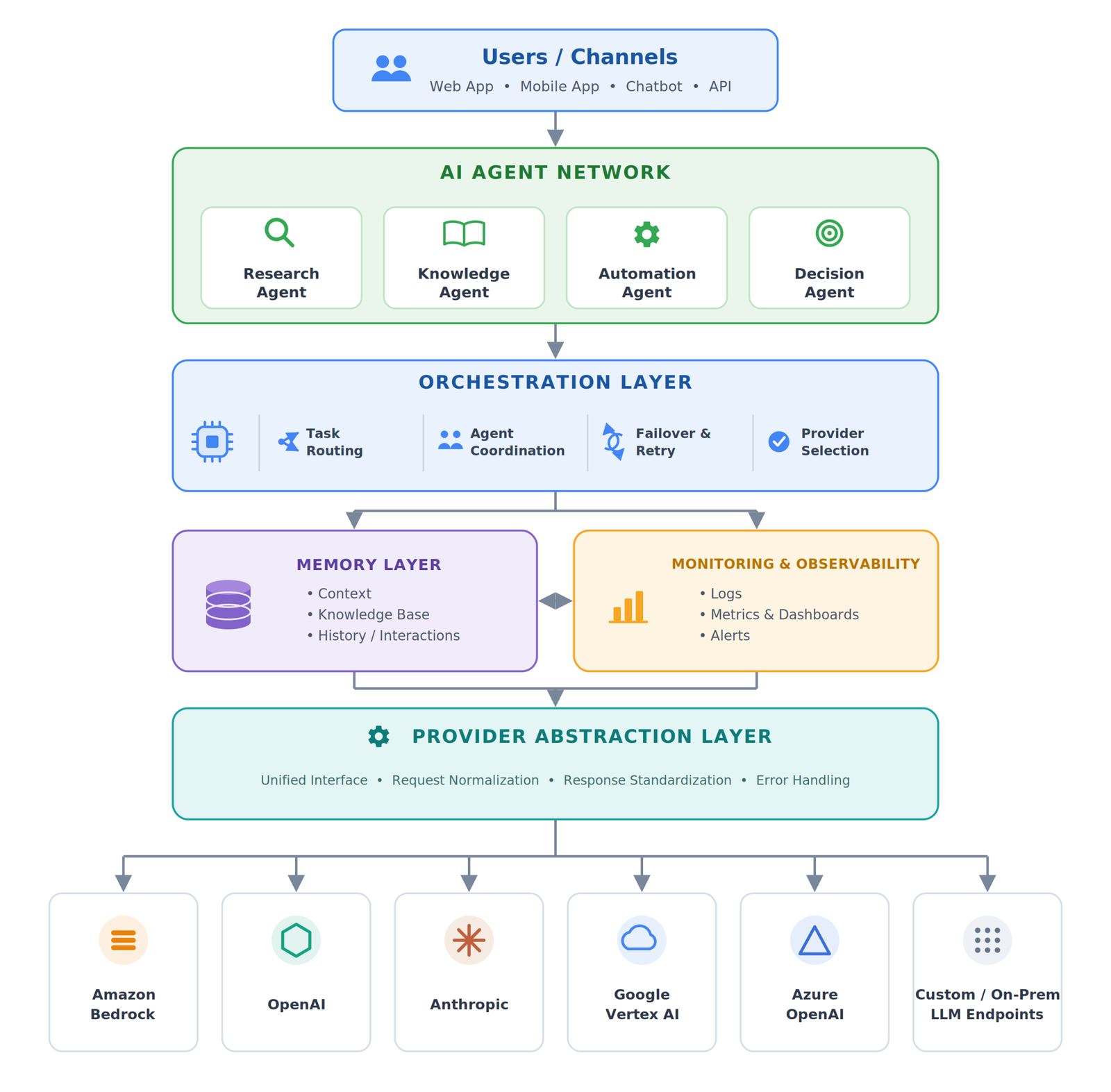
- Resilient multi-provider architectures enable businesses to embrace innovation without rebuilding entire systems every time a new model becomes available.
- Instead of being locked into yesterday’s technology decisions, organizations can continuously evolve their AI ecosystem.
Customer Expectations Continue to Rise
Modern users have little tolerance for interruptions. Whether interacting with an AI-powered customer service platform, an employee assistant, or an automated workflow, users expect:
- Fast responses.
- Accurate information.
- Consistent performance.
- Continuous availability.
Customers rarely care which AI provider is generating responses. They care about the quality of their experience. A resilient AI network focuses on delivering that experience consistently, regardless of what happens behind the scenes.
This reliability builds trust, and trust is one of the most valuable assets a business can have.
Cost Efficiency Is Becoming a Competitive Differentiator
As AI adoption scales, costs become a major consideration. Many organizations initially focus on capability but later discover that operating AI at enterprise scale can become expensive. A resilient multi-provider strategy enables businesses to avoid being tied to a single pricing model.
This flexibility helps organizations:
- Manage AI spending more effectively.
- Adapt to changing pricing structures.
- Balance performance with cost efficiency.
- Scale AI adoption sustainably.
The ability to optimize costs without sacrificing quality becomes increasingly important as AI usage grows.
Preparing for an Uncertain Future
No one can predict what the AI landscape will look like three years from now.
- New providers will emerge.
- Existing providers will evolve.
- Breakthrough technologies will redefine expectations.
- Organizations that build resilient AI foundations today position themselves to take advantage of future opportunities rather than react to future disruptions.
The question is no longer whether AI will change. The question is how prepared organizations will be when it does. Resilience provides that preparation.
Beyond Technology: A Strategic Business Decision
Building resilient AI agent networks is often viewed as a technical initiative, but its true value extends far beyond technology.
It is about:
- Protecting business operations.
- Maintaining customer trust.
- Reducing organizational risk.
- Supporting long-term growth.
- Preserving strategic flexibility.
In many ways, resilience is becoming just as important as intelligence itself. The most advanced AI solution provides little value if it cannot be relied upon when the business needs it most.
Conclusion
The conversation around AI often focuses on model performance, capabilities, and innovation. While these factors are important, organizations must also consider sustainability, reliability, and adaptability. Building resilient AI agent networks with multi-provider integration is not simply about connecting multiple AI services. It is about creating an AI ecosystem that can withstand change, adapt to new opportunities, and continue delivering value regardless of external circumstances.
As AI becomes a foundational component of modern business, resilience will separate organizations that merely adopt AI from those that successfully scale and depend on it.In the coming years, the most successful AI strategies will not be defined by a single model or provider. They will be defined by the ability to leverage many capabilities while remaining reliable, flexible, and future-ready.
